
05.01.29 Nehemiah and the Rebuilding of the Walls of Jerusalem
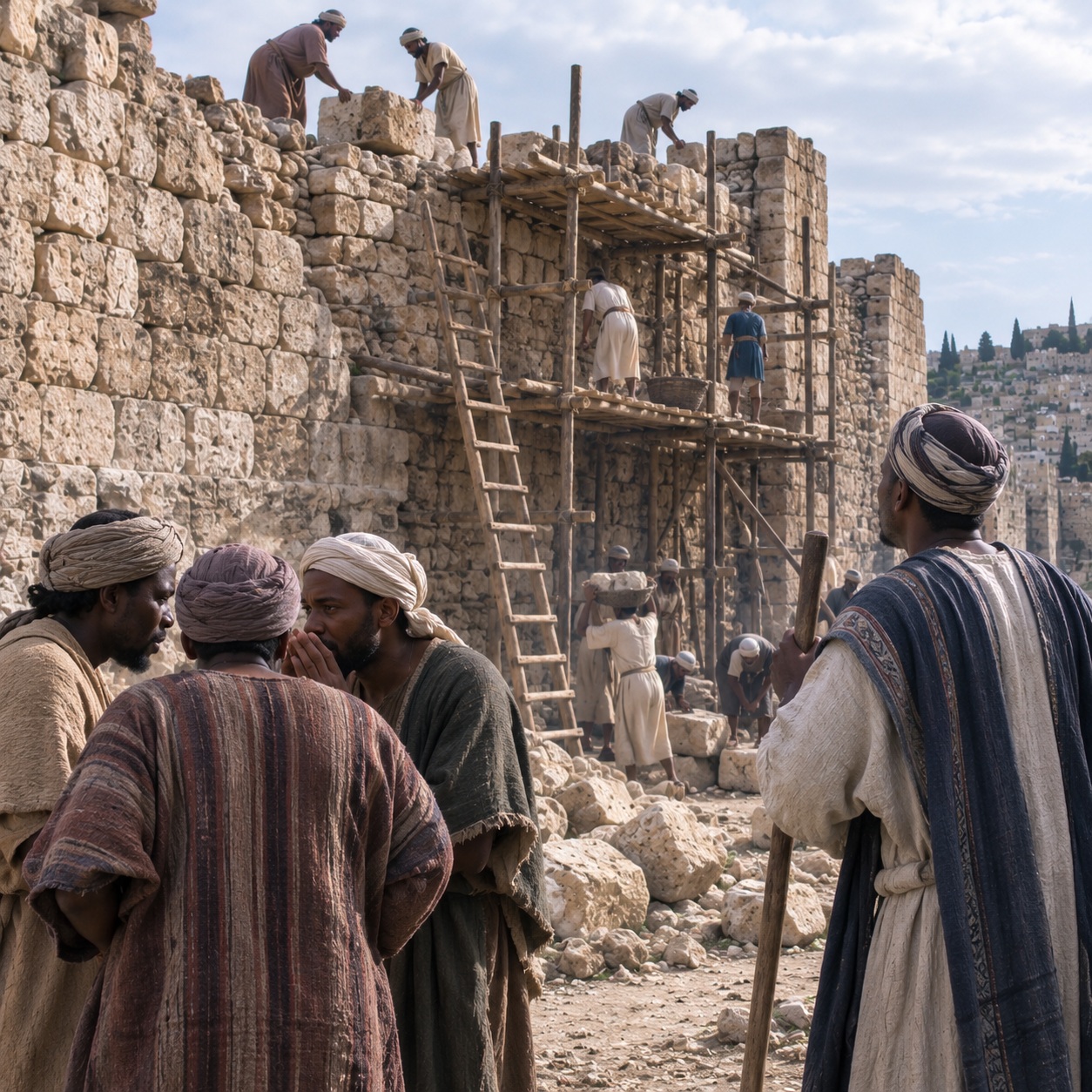
Nehemiah and the Rebuilding of the Walls of Jerusalem
A Bible Story
The story of Nehemiah and how ‘negative gossip’ was used to frustrate his efforts for rebuilding the walls of Jerusalem is most intriguing, as elaborated in the biblical account of the book of Nehemiah. The book traverses thirteen chapters which you can read to get the details.
Writers describe Nehemiah as a strong, determined, wise and extremely courageous Jewish patriot, an exile living in Persia, who was divinely called and passionately dedicated to preventing the national disintegration of Israel.
To give a short background, in 586 BC, the Babylonians had conquered Judah and destroyed the city of Jerusalem; taking Nehemiah’s ancestors and other Jews into captivity. However, in 589 BC, the Persian Empire conquered Babylon. That was how Nehemiah ended up in Persia, which is modern-day Iran, where he rose to the position of cupbearer to King Artaxerxes I. Principally, Nehemiah was responsible for tasting the king’s wine to make sure that it was not poisoned; a highly trusted, honoured and influential position, considering that the father of Artaxerxes had been murdered. To make matters even more sensitive, the current king had gained the throne through a fierce revolution. Therefore, it was Nehemiah’s job to hedge the king against any toxic attacks.
Interestingly, the Persian Empire had several capitals where the king would reside depending on the climate, accessibility and administration so as to remain in firm control of the vast empire. So, while he would reside in Persia’s summer capital, Ecbatana, during the hot months; the king and his royal court would spend the winter months in the capital of Susa, where Nehemiah lived.
Writers further narrate how Nehemiah came from a prominent and staunchly religious Jewish family, given that his father’s name, Hacaliah, contained Yah at the end, same as Nehemiah’s. Plus, his brother Hanani was a spokesman of an official delegation that visited Susa and later became governor of Jerusalem (Nehemiah 7:2). In one of their conversations during the visit, Nehemiah had asked about the condition of the city of Jerusalem and the Jews that had survived the exile, only to be told that the people were in great trouble and disgrace. Moreover, the wall of Jerusalem had broken down and the city gates burnt with fire. Nehemiah narrates how he wept, mourned, prayed and fasted after receiving that update. He was so upset that four months after Hanani’s visit, King Artaxerxes noticed. Fortunately, the sympathetic king granted Nehemiah’s request for ‘leave of absence’, to travel to Judah to rebuild the wall; giving him letters for safe passage; timber for the project; and army officers and a calvary to go with.
However, three men, Sanballat the Horonite and governor of Samaria, Tobiah the Ammonite governor and Geshem the Arabic governor of Dedan, were greatly displeased by Nehemiah’s impending project. Sanballat is reported to have been the ringleader of the trio. Therefore, on arriving in Jerusalem, Nehemiah had to secretly inspect the walls of the city by himself, moreover at night. The following morning, he successfully inspired the Jews, priests, nobles, officials and any others to participate in the work of rebuilding the wall, assuring them that the King of Persia was in support of the project.
That was when Sanballat, Tobiah and Geshem resorted to gossip as a weapon for frustrating the wall-rebuilding project. They started off by instigating that by building the wall, Nehemiah was rebelling against the king (Nehemiah 2:20). Here was his response (NIV): 20…, “The God of heaven will give us success. We his servants will start rebuilding, but as for you,you have no share in Jerusalem or any claim or historic right to it.”
It was in such a condition that the work of rebuilding the walls of Jerusalem commenced. Nehemiah 3:1 discloses how Eliashib the high priest and his colleagues were the first to participate, by rebuilding a gate and some towers which they dedicated; and how men and women of all ranks and from all walks of life including goldsmiths, perfume makers, temple servants, merchants and others, participated in the work albeit with pockets of resistance from some nobles.
Whilst all that was happening, Sanballat and Tobiah continued their negative gossip tactics. This is what Nehemiah 4:1-5 reports (NIV): 1When Sanballat heard that we were rebuilding the wall, he became angry and was greatly incensed. He ridiculed the Jews, 2and in the presence of his associates and the army of Samaria, he said, “What are those feeble Jews doing? Will they restore their wall? Will they offer sacrifices? Will they finish in a day? Can they bring the stones back to life from those heaps of rubble—burned as they are?”3Tobiah the Ammonite, who was at his side, said, “What they are building—even a fox climbing up on it would break down their wall of stones!” But rather than responding directly to their faces, Nehemiah reacted by getting God involved, praying: 4Hear us, our God, for we are despised. Turn their insults back on their own heads. Give them over as plunder in a land of captivity. 5Do not cover up their guilt or blot out their sins from your sight, for they have thrown insults in the face of the builders.
With Nehemiah maintaining his focus on the project, the wall got to half its height; provoking Sanballat, Tobiah, the Arabs, the Ammonites and the people of Ashdod to threaten attacking the builders. Nehemiah and his team had to post guards day and night as a security measure. Even then, the builders started feeling weaker, fearing to be assaulted or killed, thence prompting Nehemiah to arm them with spears, shields, bows and armor in addition to encouraging them to remember the Lord and fight for their families.
People were working day and night; and in no time, the work was almost complete apart from setting the doors in the gates. That was when Sanballat and Geshem the Arab invented a false and treasonous rumour, as reported in Nehemiah 6:1-8 (TLB): 1When Sanballat, Tobiah, Geshem the Arab, and the rest of our enemies found out that we had almost completed the rebuilding of the wall—though we had not yet hung all the doors of the gates— 2they sent me a message asking me to meet them in one of the villages in the plain of Ono. But I realized they were plotting to kill me, 3so I replied by sending back this message to them: “I am doing a great work! Why should I stop to come and visit with you?” 4Four times they sent the same message, and each time I gave the same reply. 5-6The fifth time, Sanballat’s servant came with an open letter in his hand, and this is what it said: “Geshem tells me that everywhere he goes he hears that the Jews are planning to rebel, and that is why you are building the wall. He claims you plan to be their king—that is what is being said. 7He also reports that you have appointed prophets to campaign for you at Jerusalem by saying, ‘Look! Nehemiah is just the man we need!’ “You can be very sure that I am going to pass along these interesting comments to King Artaxerxes! I suggest that you come and talk it over with me—for that is the only way you can save yourself!” 8My reply was, “You know you are lying. There isn’t one bit of truth to the whole story. Writers elaborate how Geshem was in control of the great trade routes in his region of influence, and that he could have easily used them as a conduit to propel the rumour to the Persian king; a fact which Nehemiah chose to ignore.
After completing the wall-rebuilding project in a record 52 days (Nehemiah 6:15), Nehemiah was appointed governor in the land of Judah; and made sure to go an extra mile to ensure that the needy were looked after and that people had enough food. However, the negative gossip and opposition continued. Specifically, a man named Shemaiah was bribed to use false prophecy as a bait. See how Nehemiah 6:10-13 reports that incident (NIV): 10One day I went to the house of Shemaiah son of Delaiah, the son of Mehetabel, who was shut in at his home. He said, “Let us meet in the house of God, inside the temple, and let us close the temple doors, because men are comingto kill you—by night they are coming to kill you.” 11But I said, “Should a man like me run away? Or should someone like me go into the temple to save his life? I will not go!” 12I realized that God had not sent him, but that he had prophesied against me because Tobiah and Sanballat had hired him. 13He had been hired to intimidate me so that I would commit a sin by doing this, and then they would give me a bad name to discredit me. Apparently, Shemaiah would team up with a prophetess named Noadiah, and other prophets to intimidate Nehemiah.
The bible also discloses that alarmingly, ‘gossipy’ letters would be ferried between Tobiah and the nobles of Judah. Unashamedly, while the dignitaries were telling Nehemiah about how good Tobiah was; the Ammonite governor was sending intimidating letters to Nehemiah at the very same time. The close relationship between Tobiah and the Jewish nobles was fueled by the fact that Tobiah was a son-in-law of Shekaniah a Jewish leader. Plus; Tobiah’s son, Jehohanan, was also married to the daughter of a Jewish leader named Meshullam (Nehemiah 6:17-18).
In the process of time, Nehemiah returned to Susa for a brief period. But no sooner had he left than Eliashib the priest, who had a very close relationship with Tobiah, did the ‘detestable’. Nehemiah 13:4-5 reports what happened (TLB): 4…, Eliashib the priest, who had been appointed as custodian of the Temple storerooms and who was also a good friend of Tobiah, 5had converted a storage room into a beautiful guest room for Tobiah. The room had previously been used for storing the grain offerings, frankincense, bowls, and tithes of grain, new wine, and olive oil. Moses had decreed that these offerings belonged to the priests, Levites, the members of the choir, and the gatekeepers. The connection between Eliashib and Tobiah must have been accentuated by the fact that one of Eliashib’s children was Sanballat’s son-in-law. So, not only did Nehemiah throw Tobiah’s things out of the Temple, but he quizzed Eliashib and his fellow priests on how they could have ever allowed such a thing to happen; having to purify the Temple as a result.


